
The Contingency Dagger
- May 28
- 3 min read

"Hilton shoved the man away from him and back-peddled, hands digging under his shirt once more. The man regained his balance and charged Hilton with the screwdriver, but Hilton’s hand came back up with a double-edged Contingency dagger just as the two collided like linebackers..."
In the opening page of Close And Destroy's prologue, a member of Windsor Kraft's Reconnaissance Troop employs a knife in close combat referred to as the Contingency. At the time I wrote this scene, such a knife didn't exist. I had originally penned in a brand of fixed blade I've favored on and off over the years. But it didn't feel quite right for this scene. So I re-wrote the scene with a different manufacturer. Then another. Then another. At the end of the day there just wasn't a knife I felt really embodied what I wanted for Hilton in a concealable, self-defense fixed blade.
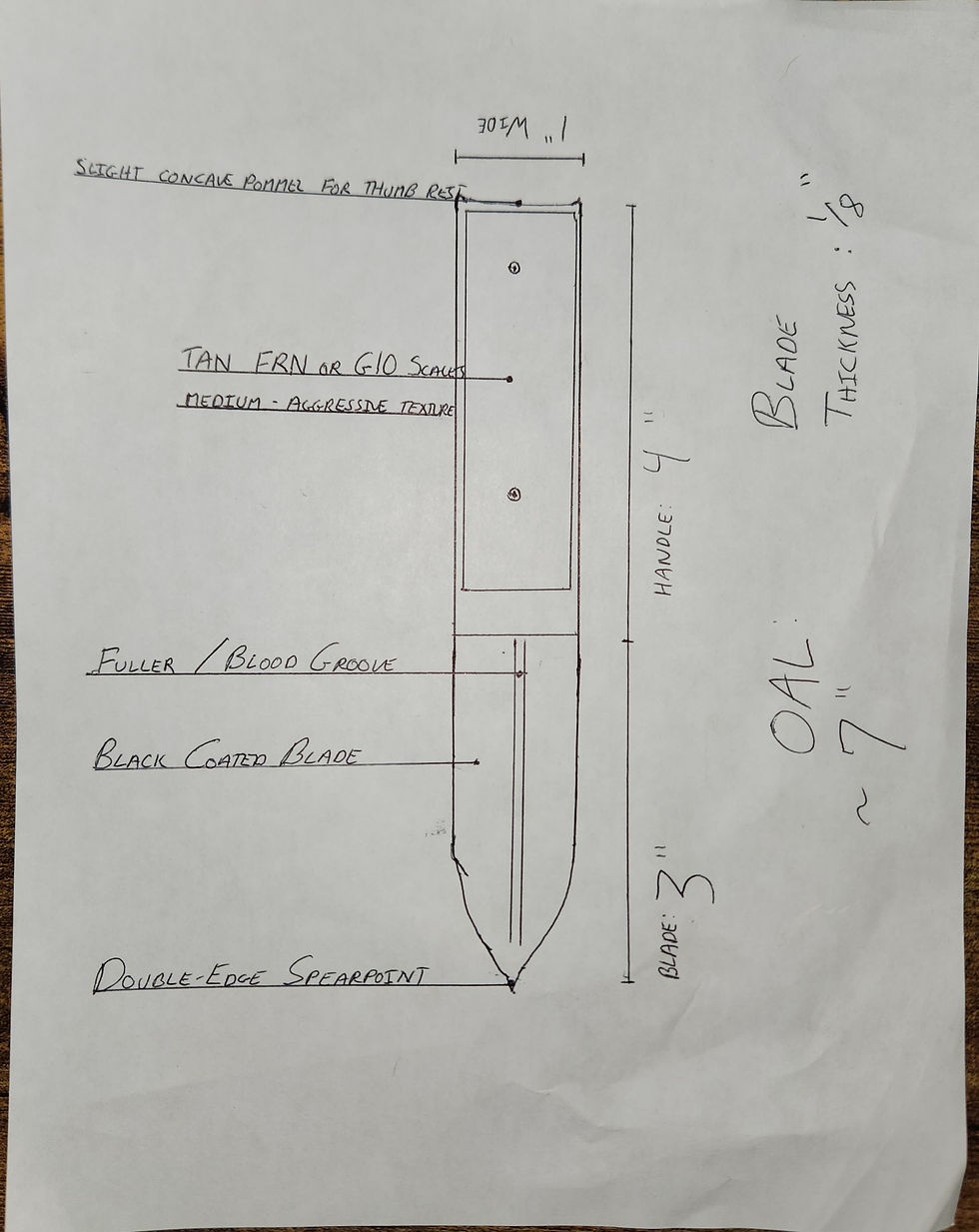
Then, weeks before going to press, I got introduced to the team at Colonel Blades. We had a laid-back, but direct conversation about what I wanted in a knife and why. I sent them the prologue of the book. I talked about my desire to have a tangible, practical, real-world product that was birthed from the pages of fiction, and how we could possibly tell that story. Less than a week later I was working with CB's lead designer, Steve. We traded text messages back and forth for a couple of days. I sent him a sketch on a piece of printer paper that looked like a grade-schooler's impression of a knife. There were some things I knew I needed to have:
a double-edge blade
a spear point
aggressively textured grip scales
a way to lock in your thumb when "capped" over the pommel
a generally straight profile with no protruding guards
it had to be short enough to conceal but long enough to penetrate sufficiently
the knife itself had to be completely agnostic of "fighting style", able to be used right- or left-handed in point-up or point-down grip, with no concern about whether the edge was facing in or out (hence my requirement for a double-edged design)
Steve provided some gentle design input and rapid-prototyped a 3D-printed model, which he mailed to me next day. We went back and forth for a couple of weeks, tweaking one thing or another. We went through a half-dozen of those blue plastic 3D-printed models until we finally had firm vision of the final product.

What resulted was a 7-5/8" long knife with a 3-1/2" blade that is available in single- or double-edge configurations. We also added heavy jimping to the arched pommel to lock in your thumb when using an "ice pick" or tip-down grip, as well as along both sides to secure the blade in your hand. The bottle-shaped grip enhances ergonomics while the G10 scales were diamond checkered to provide solid grip while providing a subtle nod to the iconic grip scales found on 1911 pistols.
The steel is Japanese AUS8 - a well rounded steel that is generally regarded as above average for corrosion resistance, edge retention, and overall blade toughness while still being highly afforadble. This balance was important because I wanted a working knife, not an artisan collector piece. Well-balanced and long-lasting, this knife is meant to be used. Easily sharpened as needed, easily replaceable when necessary. With an MSRP of $89.99 for the double-edge variant, this knife was also intended to be easily affordable to the people who might need it most - professional first-responders and responsibly armed citizens.
Then we had to name it.
The military has a mission preparedness principal called PACE Planning. The acronym stands for:
Primary
Alternate
Contingency
Emergency
The idea is to have a four-layered plan (or as many as you can get) which accounts for increasing levels of adversity or multiple failure points. Applied to the context of Windsor Kraft contractors providing armed services in a conflict zone, the individual's Primary weapon is their carbine.
Their secondary, or Alternate weapon, is their sidearm. That would make their tertiary, or Contingecy weapon a knife carried concealed or on their kit. This led to the naming of my knife design as the Contingency Dagger - a third line option when rifles and pistols are unavilable, or fail in succession, or to function as a weapon-retention tool in close quarters situations.

The Contingency is available for purchase directly from Colonel Blades. Each knife comes with a Windsor Kraft branded presentation case, kydex sheath with steel pocket clip, and a signed paperback copy of Close And Destroy. I'm also proud to have been inducted into the Colonel Blades "Operator's Guild" alongside my friend and SWAT officer Chris Kuras.


Comments